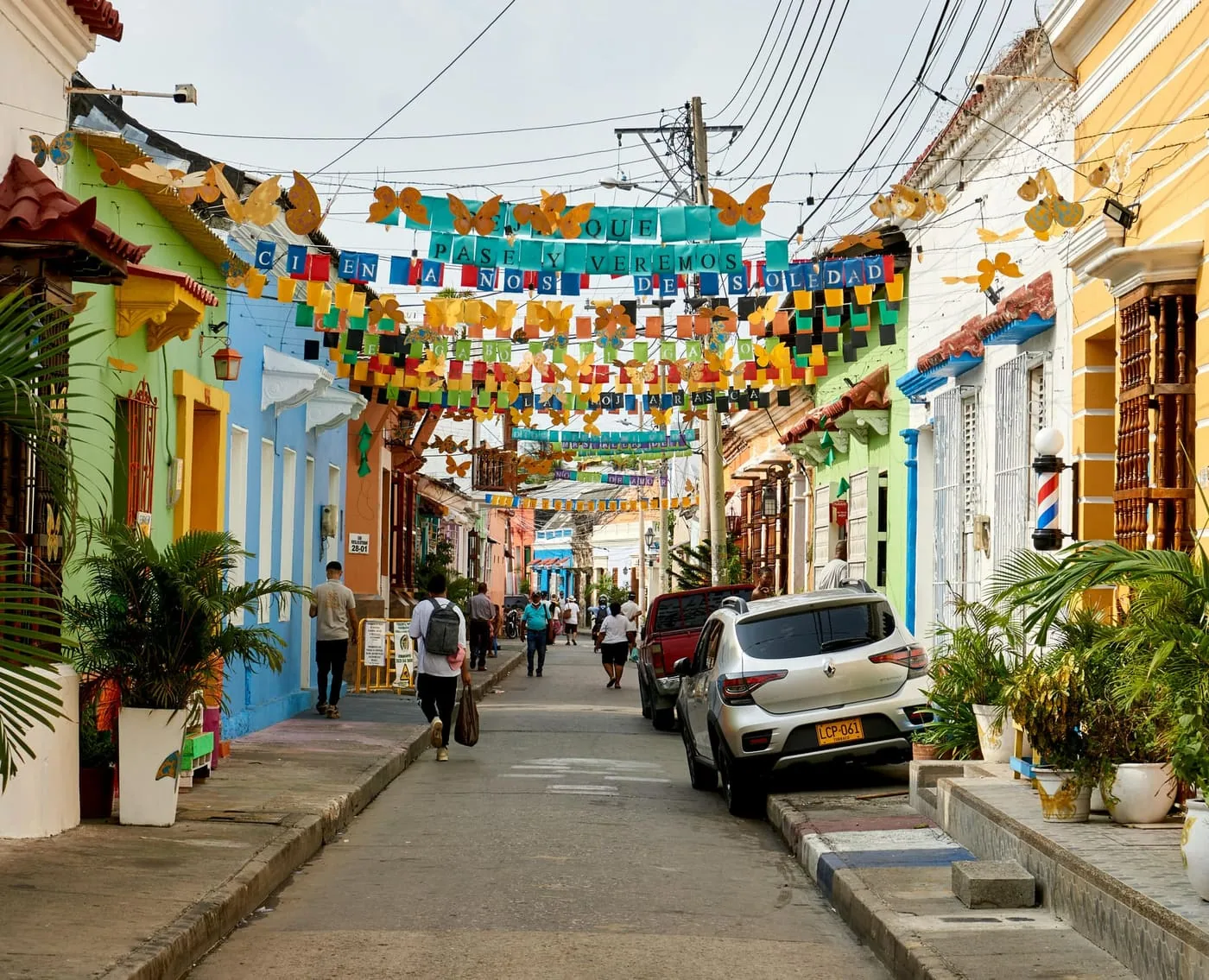
Cartagena de Indias is a city that carries centuries of history in every stone of its walls. But behind the name lies a story of conquest, geographic error, imperial greed, and resistance that few cities in the world can match. To understand Cartagena today, you have to know how it became what it is.
Before the Spanish: the Calamari people
Before any European arrived, the bay we know today as the Bay of Cartagena was the territory of the indigenous Calamari people. They were expert fishermen and navigators who knew the currents, the fish, and the cycles of the sea with a precision that took Europeans decades to match. The word "calamari" that gave them their name is also the origin of the name the Spanish initially used for the region.
The Calamari weren't alone. The region was also home to various Zenú communities, famous for their gold metalwork, their agricultural canal systems, and their mastery of natural-fiber weaving. The "sombrero vueltiao," today a Colombian national symbol, has its roots in the Zenú tradition of these lands.
Pedro de Heredia and the founding of 1533
On June 1, 1533, the conquistador Pedro de Heredia, from Extremadura, Spain, landed in the bay with a small group of Spanish soldiers and declared the city of Cartagena founded. The name was a direct tribute to Cartagena de Levante, the port city in southeastern Spain where Heredia had served before crossing the Atlantic.
The choice of the bay was no accident. The geography was perfect for a colonial port: a deep-water bay protected from the open sea by the island of Tierra Bomba, with favorable currents for navigation and easy to defend from land. The Spanish immediately recognized they had an exceptional natural harbor in their hands.
Fun fact: Pedro de Heredia arrived in Cartagena with barely 150 men. In less than a century, the city he founded would become the most important trading port of the Spanish Empire in the New World.
Why "de Indias"? History's most famous mistake
When Christopher Columbus reached the Caribbean islands in 1492, he was convinced he had reached the East Indies, the European name for the Asian subcontinent and the islands of Indonesia and Malaysia. He never knew he had found a continent completely unknown to Europeans.
As a result of that historic mistake, the entire American continent was recorded as "the Indies" in the documents of the Spanish Crown. The native peoples were called "Indians" (an incorrect name that persists to this day), and every new city founded in the Americas carried the suffix "de Indias" to distinguish it from its namesake cities in Spain.
So Cartagena needed to be distinguished from Cartagena in Spain, and the suffix "de Indias" was etched into its name forever. A centuries-old geographic mistake that today defines the identity of one of the most beautiful cities in the world.
The most coveted treasure: why everyone wanted Cartagena
By the mid-16th century, Cartagena de Indias had become the starting point of the Spanish fleet system that carried gold and silver from the New World to the Iberian Peninsula. Every year, dozens of ships loaded with precious metals from Peru, New Granada, and Mexico passed through Cartagena before crossing the Atlantic.
This wealth made Cartagena the favorite target of the pirates and privateers who roamed the Caribbean. Francis Drake sacked the city in 1586 over 101 days, carrying off everything he could load. The Baron de Pointis attacked it in 1697 with a fleet of 65 ships. Admiral Edward Vernon tried to take it in 1741 with the largest army ever sent to the Caribbean (186 ships, 23,600 men) and was defeated by the heroic Blas de Lezo with just 6 ships and 3,000 men.
The wall: 200 years to protect a treasure
After Drake's sack, the Spanish Crown decided Cartagena had to become impregnable. Construction of the walls that are today a World Heritage Site began in 1586 and wasn't completed until the late 18th century: more than 200 years of continuous work. The walls stretch for 11 kilometers, are up to 17 meters thick in some places, and were designed by the best military engineers of the Spanish Empire.
The defensive system includes the imposing Castillo de San Felipe de Barajas (built on the Cerro de San Lázaro hill), the walls of the Centro Histórico, the forts of Boca Chica and Boca Grande, and a series of strategically placed bastions and batteries covering every angle of approach to the bay.
Independence: November 11, 1811
Cartagena has the honor of being the first city in Colombia to declare absolute independence from Spain, on November 11, 1811. That day is a national holiday and is celebrated with the Independence Festival, one of the country's most important cultural events, with parades, dance troupes, and music filling the streets for a week.
Cartagena's independence saga includes the epic "siege of Cartagena" in 1815, when Simón Bolívar had already fled to Jamaica and royalist troops under General Pablo Morillo besieged the city for 108 days. Thousands of Cartagena's residents died of hunger and disease before the city fell. For that sacrifice, Bolívar called Cartagena "La Heroica" (The Heroic City), a name it carries with pride to this day.
Cartagena today: World Heritage Site
In 1984, UNESCO declared the Port, Fortresses, and Monumental Group of Cartagena a World Cultural Heritage Site, recognizing the exceptional integrity with which its colonial architecture and defensive systems have been preserved.
Today Cartagena welcomes more than 2 million tourists a year, is Colombia's most important tourist destination, and remains a living city where colonial history coexists with modern Caribbean culture. The walls built to guard Spanish gold now guard something even more valuable: the memory of centuries of American history.
Frequently asked questions
When was Cartagena de Indias founded?
On June 1, 1533 by Pedro de Heredia. It is one of the oldest cities in the Americas and a UNESCO World Heritage Site since 1984.
Why is it called "de Indias"?
Because of Columbus's mistake of calling the Americas "the Indies." The suffix was added to distinguish it from Cartagena, Spain.
Who lived there before the Spanish?
The indigenous Calamari people, who gave the bay its original name, and Zenú communities famous for their gold metalwork.
Why is it called "La Heroica"?
Because of the 1815 siege, when Cartagena's residents endured 108 days of Spanish blockade, dying of hunger rather than surrender. Bolívar gave the city that name in honor of their sacrifice.